Clean & Classic: Why Line Art Icons Still Win in Design
There's something undeniably elegant about simplicity. In a world saturated with complex gradients, 3D effects, and hyper-realistic imagery, the clean precision of a single line cuts through the noise. For designers working in the wedding, event, or lifestyle space, the challenge often lies in finding visual assets that feel both timeless and versatile. Enter the power of monochromatic illustration. A well-crafted set of black and white graphics offers a foundation that can adapt to any color palette, any medium, and any brand personality without ever feeling dated. It’s the visual equivalent of a perfect little black dress—always appropriate, endlessly adaptable, and inherently sophisticated.
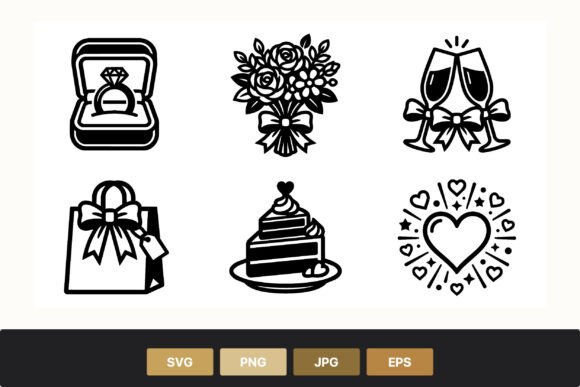
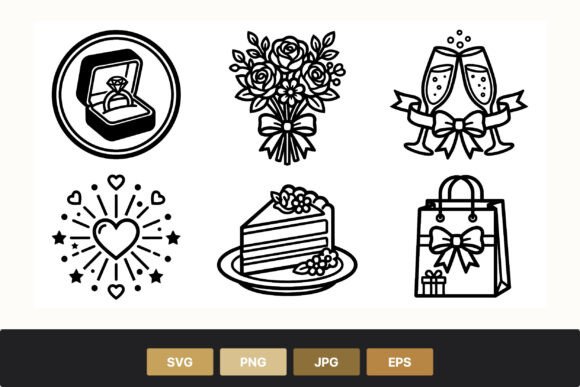
Today, we're looking at a specific collection that embodies this principle: the Wedding Icons Black White Line Art set. This isn't just a random assortment of shapes; it's a curated suite of six essential symbols—the diamond ring, the bouquet, the champagne toast, the heart, the cake slice, and the gift. Each is rendered in a continuous, flowing line style that feels both hand-drawn and professionally polished. This particular aesthetic bridges the gap between organic warmth and structured clarity, making it a powerful tool for anyone building a visual narrative around celebration, love, or luxury.
More Than Just Pretty Pictures: The Strategic Value of Line Art
At first glance, a set of icons might seem like a minor detail in the grand scheme of a design project. But think about the last brand you loved. Its visual identity was likely consistent across every touchpoint—from its website favicon to its packaging tape. Consistency builds recognition, and recognition builds trust. This is where a cohesive icon set becomes a strategic asset, not just a decorative one.
The Wedding Icons Black White Line Art set, for instance, provides a unified visual language. Because all six icons share the same line weight, style, and level of detail, they can be used together seamlessly. This creates instant visual harmony. Imagine a wedding planner using the ring icon for "Ceremony," the champagne glasses for "Reception," and the gift bag for "Registry" on their website navigation. The user intuitively understands the system, and the brand looks meticulously put-together. This kind of thoughtful detail elevates a project from amateur to professional in a heartbeat.
Furthermore, the monochromatic nature of these icons is a huge practical advantage. You can drop them onto a pastel background for a soft, romantic feel, or place them against a deep navy or forest green for a more modern, dramatic look. They work equally well on cream-colored textured paper for a vintage invitation and on a stark white screen for a clean, minimalist app interface. This flexibility means you purchase one asset and unlock dozens of potential applications, saving you time and money while maintaining a tight brand identity.
From Screen to Print: A Toolkit for Every Creative Workflow
The true test of any design asset is its utility across different formats and production methods. A beautiful graphic that only works on a website is limiting. A truly valuable resource must transition smoothly from digital screens to physical products. This is where the technical offering of this particular set shines. The download package is provided as a compressed ZIP file that conveniently bundles multiple file formats—including SVG for scalable vector editing, PNG for transparent background usage, EPS for professional design applications, and JPG for standard image compatibility—ensuring flexibility across a wide range of creative and production workflows.
Let's break that down into real-world scenarios. A social media manager can grab the PNG files with transparent backgrounds to quickly create Instagram story templates or Pinterest pins. A graphic designer working on a client's full brand suite can open the SVG or EPS files in Adobe Illustrator to customize colors, adjust line thickness, or integrate the icons into a larger logo mark. A small business owner creating their own wedding favors can use the high-resolution JPGs to print directly onto tags or boxes. The versatility built into the file formats means this single resource can serve a blogger creating a header image, a printer preparing a foil-stamped invitation, and an app developer designing a user interface—all at the same time.
Consider the slice of cake icon. On a website, it could be an elegant button leading to a dessert menu. Printed on a sticker, it seals a favor box. Embroidered on a napkin, it becomes part of a table setting. The heart with decorative rays can be a watermark on a letterhead, a social media profile frame, or a subtle background pattern on a wedding website. This kind of cross-media consistency is what separates a cohesive brand experience from a disjointed collection of pretty things.
Practical Integration: Making These Icons Work for You
So, you've downloaded the set. Now what? The key is to use these icons with intention, not just as afterthoughts. Here are some practical ways to integrate them into your projects for maximum impact.
First, think about visual hierarchy and emphasis. Use an icon to draw the eye to a key piece of information. Place the champagne glass icon next to the "Toast" section of an event timeline. Use the flower bouquet icon as a bullet point in a list of floral arrangement options. This breaks up text, adds visual interest, and guides the reader's journey through your content in a more engaging way.
Second, use them to build a subtle pattern or texture. By repeating a single icon—like the diamond ring—at a low opacity in the background of a document or on a website section, you create a branded texture that adds depth without overwhelming the main content. This is a sophisticated technique often seen in high-end editorial design and luxury packaging.
Third, don't be afraid to customize and combine. While the set is beautiful as-is, its real power is unlocked in vector editing software. You could outline the gift bag icon and place a monogram inside it for a personalized logo. You could take the decorative rays from the heart icon and apply them as a standalone border element. The clean line work is designed to be a starting point for your creativity, not a rigid endpoint.
Finally, always keep your audience and medium in mind. For a printed, high-end lookbook, you might use the icons in a single, elegant color like gold or silver ink. For a mobile-first website, ensure the icons are clear and recognizable at very small sizes. Test them in context. Do they look good next to your chosen typeface? Does the style of the line art complement or clash with your photography? A little testing upfront ensures a polished final product.
A Foundation for Timeless Branding
Ultimately, assets like the Wedding Icons Black White Line Art set are about building a foundation. They provide a consistent visual thread that can tie together disparate elements of a project or brand. In a fast-moving digital landscape where trends come and go, the clarity and simplicity of well-executed line art offer a sense of permanence and reliability. It communicates care, attention to detail, and a respect for classic aesthetics—qualities that resonate deeply in the wedding and event industry, but also in broader lifestyle, boutique, and luxury branding.
Whether you're a designer assembling a mood board for a client, a small business owner crafting your own marketing materials, or a content creator looking to add a professional polish to your blog, having a versatile set of high-quality, stylistically cohesive icons in your toolkit is a smart move. It streamlines your workflow, strengthens your visual identity, and ultimately helps you communicate your message with greater clarity and elegance. In the end, great design isn't about using the most complex tools; it's about using the right tools with skill and intention. Sometimes, the most powerful tool is a single, perfect line.